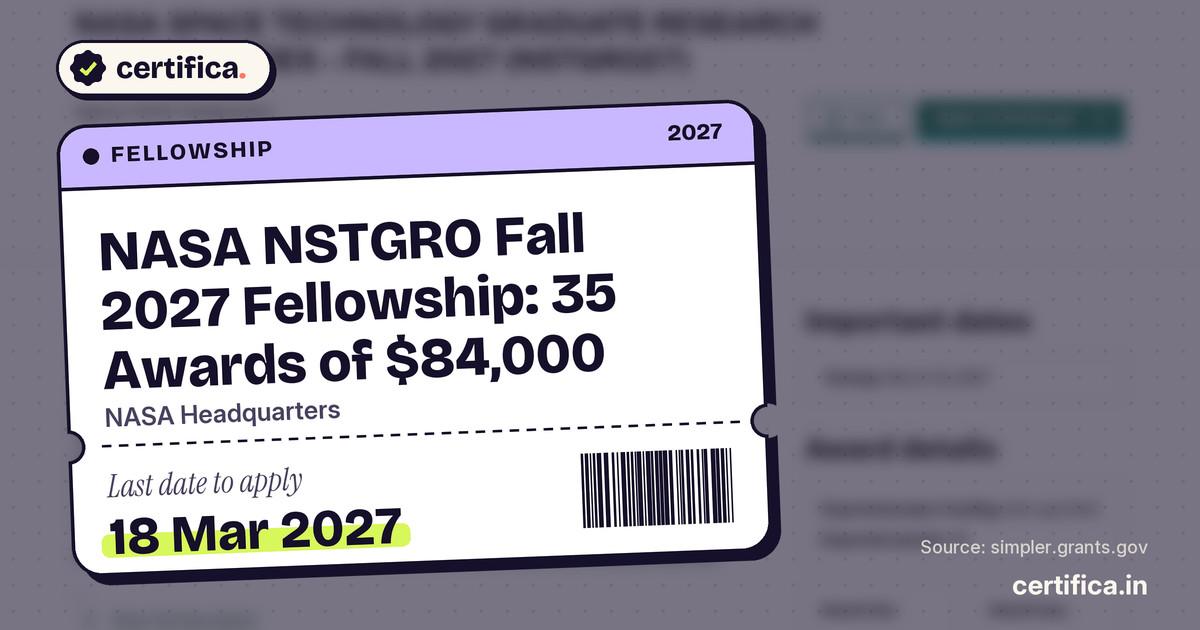
NASA NSTGRO 2027 Fellowship - $84,000 Award, Apply by Mar 18
Facts checked: against the official notice at simpler.grants.gov on 15 November 2026.
Quick Summary
| Item | Details | What it means |
|---|---|---|
| Update Type | Fellowship | What this post is about |
| Organisation | NASA Headquarters | Body conducting this fellowship |
| Post / Exam | NASA Space Technology Graduate Research Opportunities – Fall 2027 (NSTGRO27) | Name of the post, exam or programme |
| Advertisement No. | NNH26ZTR001N-26NSTGRO-B4 | Official notification reference number |
| Total Vacancies | 35 | Number of posts or seats announced |
| Application Mode | Electronic submission through NSPIRES | How to apply (online or offline) |
| Last Date | March 18, 2027 | Final day to submit the application |
| Salary / Stipend | Award max. $84,000 | Pay scale or monthly stipend offered |
| Eligibility | U.S. citizen, U.S. national, and permanent-resident graduate-student research; Individuals pursuing or planning to pursue master's or doctoral (Ph.D.) degrees… | Minimum qualification needed to apply |
| Selection Process | Two-step process where preliminary proposals are mandatory, and only those invited may submit a full proposal → Mandatory preliminary proposals due December 9,… | Stages candidates go through |
| Official Website | simpler.grants.gov | Apply and download the official notification here |
Applications for NASA Space Technology Graduate Research Opportunities – Fall 2027 (NSTGRO27) will close on March 18, 2027, as per the official notification. NASA Headquarters offers this fellowship to U.S. citizens, U.S. nationals and permanent residents pursuing full-time master’s or doctoral research in space technology disciplines at U.S. institutions. Indian citizens studying in India without U.S. permanent-resident status are not eligible; see the official announcement for solicitation NNH26ZTR001N-26NSTGRO-B4.
NASA Space Technology Graduate Research Opportunities 2027: Overview
NASA Space Technology Graduate Research Opportunities – Fall 2027 (NSTGRO27) is a graduate fellowship from NASA Headquarters that funds master’s or doctoral research in relevant space technology disciplines, as per the official notification.
The programme is identified by solicitation NNH26ZTR001N-26NSTGRO-B4 and plans for 35 awards. Each award is capped at a maximum value noted in the Benefits section, and all submissions must go through electronic submission as specified by NASA.
How this round is structured
Unlike a single-deadline grant, NSTGRO27 uses a mandatory preliminary stage followed by an invited full-proposal stage. That structure means a student cannot skip directly to the final application, and university research offices must be involved early to complete the required registrations. Details of the ceiling and the timeline appear in their respective tables below, with the official website as the reference point.
NASA Space Technology Graduate Research Opportunities 2027 Fellowship Benefits
NSTGRO27 provides research support up to the capped award value shown in the table below, as per the official notification.
The amount is a maximum, not a fixed payment made to every fellow. NASA Headquarters sets the same ceiling for each of the planned awards in this round, and the actual allocation depends on the approved research scope and institutional terms described in the solicitation.
What the ceiling covers in practice
Students should read the award terms in the notification to see how fellowship funds interact with tuition, fees and research costs at their U.S. institution. Because the figure is an upper limit, budgets submitted with the full proposal must fit within it rather than assume automatic receipt of the full sum.
NASA Space Technology Graduate Research Opportunities 2027 Eligibility Criteria
Only U.S. citizens, U.S. nationals and permanent-resident graduate students who meet the enrolment and degree conditions can apply for NSTGRO27.
- U.S. citizen, U.S. national, and permanent-resident graduate-student research
- Individuals pursuing or planning to pursue master's or doctoral (Ph.D.) degrees in relevant space technology disciplines at U.S. institutions of higher education (IHEs)
- Must have a bachelor's degree prior to the fall 2027 term
- Must be enrolled in a full-time master's or doctoral degree program at a U.S. IHE at the start of the fall 2027 term
The official notification limits the programme to individuals pursuing or planning to pursue master’s or doctoral degrees in relevant space technology disciplines at U.S. institutions of higher education. Applicants must already hold a bachelor’s degree before the fall term and be enrolled full-time in an eligible graduate programme at a U.S. institution when that term begins.
What this means for Indian students
Indian citizens studying in India, or Indian students abroad who are not U.S. citizens, U.S. nationals or U.S. permanent residents, do not meet the citizenship condition and cannot apply. An Indian passport holder can be considered only if they independently satisfy the stated U.S. permanent-resident requirement and the U.S. enrolment requirement.
Who is also out of scope
Part-time enrolment, enrolment at a non-U.S. institution, or starting graduate study without the required prior bachelor’s degree before the fall term does not satisfy the stated terms. Applicants planning a discipline outside space technology should check the solicitation’s relevance criteria before preparing a preliminary proposal.
NASA Space Technology Graduate Research Opportunities 2027 Important Dates and Deadline
NSTGRO27 follows a two-point timeline with a mandatory early stage and a later invited stage, as per the official notification.
| Event | Date |
|---|---|
| Notification Date | November 10, 2026 |
| Last Date to Apply | March 18, 2027 |
The table below lists the notification entry published on November 10, 2026, alongside the final closing entry. Readers should treat the two entries as linked: the early preliminary submission determines who is allowed to use the final closing entry.
Why the two entries should be read together
The preliminary proposal is not optional and missing it removes the chance to submit later, even if the final date has not passed. University proposal offices often need internal lead time for electronic submission, so the interval between the two points is for invitation decisions and full-proposal preparation, not for starting a first draft.
How to Apply for NASA Space Technology Graduate Research Opportunities 2027
Applications for NSTGRO27 must be prepared and submitted electronically through NSPIRES in line with solicitation NNH26ZTR001N-26NSTGRO-B4.
For steps or documents not described in the summary, refer to the official notification. The sequence below follows the mandatory two-stage rule stated by NASA Headquarters:
- Go to the apply online portal and open solicitation NNH26ZTR001N-26NSTGRO-B4 to confirm eligibility and research relevance.
- Coordinate with your U.S. institution’s sponsored research or proposal office for NSPIRES registration and authorisations.
- Prepare and submit the mandatory preliminary proposal through NSPIRES by the stated preliminary deadline.
- Wait for NASA’s invitation decision; only invited proposers may proceed to the next stage.
- If invited, prepare the full proposal with research plan, budget within the capped amount, and institutional endorsements exactly as instructed in the invitation and solicitation.
- Submit the invited full proposal electronically through NSPIRES by the final closing date and retain the submission confirmation.
Field-level caution
NSPIRES validates institutional affiliation and proposal type before allowing submission, so selecting the wrong solicitation number or submitting as an unaffiliated individual leads to rejection. The preliminary and full proposals use different submission windows in the same system, so verify that you are in the correct stage before uploading.
NASA Space Technology Graduate Research Opportunities 2027 Selection Process
NASA Headquarters selects NSTGRO27 fellows through a mandatory two-step process in which only invited preliminary proposers may file a full proposal.
- Two-step process where preliminary proposals are mandatory, and only those invited may submit a full proposal
- Mandatory preliminary proposals due December 9, 2026, 6 pm Eastern Time; target deadline for invited full proposals March 18, 2027
The preliminary proposals were due December 9, 2026, at 6 pm Eastern Time, and NASA reviews that pool to decide invitations. The invited full-proposal stage then uses the final closing date noted in the introduction, with no direct entry for those who did not clear the first screen.
How the screen works
The first screen tests relevance to space technology and basic eligibility rather than full technical detail. The second screen is the comprehensive technical and feasibility assessment of the invited research plan. Because progression is strictly sequential, strength in the full-proposal format cannot compensate for absence from the preliminary pool.
NASA Space Technology Graduate Research Opportunities 2027: Tips and Common Mistakes
Common mistakes and rejection reasons
- Do not apply as an individual student. Your accredited U.S. university must submit the NSTGRO proposal with your faculty advisor as principal investigator. (nasa.gov)
Tips from the organisation and past applicants
- Only U.S. citizens and permanent residents can be sponsored, so Indian students without U.S. permanent residency or citizenship are not eligible for NSTGRO. (nasa.gov)
- You must fit one of the NSTGRO solicitation's eligibility profiles to submit, so check that table before preparing a proposal. (nasa.gov)
- Expect to be paired with a NASA Subject Matter Expert who serves as your NSTGRO research collaborator and link to the wider technical community. (nasa.gov)
- Plan for the visiting technologist experience: NSTGRO awardees perform part of their research on-site at NASA Centers. (nasa.gov)
From earlier cycles
- For the NSTGRO24 solicitation issued in 2023, NASA expected to make approximately 55 new awards if enough highly meritorious proposals were received. (grad.msstate.edu)
- By the NSTGRO24 round announced in 2023, NASA had made over 700 NSTGRO awards to students at over 110 universities across 42 states and one U.S. territory. (grad.msstate.edu)
- In 2023, NASA's Space Technology Research Grants program hit its thousandth award through the then most-recent NSTGRO cohort. (nasa.gov)
NASA Space Technology Graduate Research Opportunities 2027 Important Links
All authoritative documents and submission access for NSTGRO27 flow from the single federal opportunity entry listed in the table below.
| Link | URL |
|---|---|
| Official Website | simpler.grants.gov |
Use that entry to verify the solicitation text, any amendments, and the electronic submission path. NASA Headquarters issues updates only through that channel, so versions saved from other sites should not be relied on for deadlines or forms.
Which link to use when
Start from the download notification entry to read NNH26ZTR001N-26NSTGRO-B4 in full before creating an NSPIRES draft. The same entry routes to the submission system for both the preliminary and invited full-proposal stages.
Frequently Asked Questions
What is the last date to apply for the NASA Space Technology Graduate Research Opportunities Fall 2027 Fellowship?
The last date to apply is March 18, 2027, which is the target deadline for invited full proposals.
Who is eligible for NSTGRO27?
U.S. citizens, U.S. nationals and permanent residents who are pursuing or plan to pursue a master's or doctoral degree in a relevant space technology discipline at a U.S. institution of higher education can apply. Applicants must hold a bachelor's degree before the fall 2027 term and be enrolled full-time in a master's or doctoral program at the start of that term.
What is the award amount for NSTGRO27?
The fellowship offers an award of up to $84,000.
How can I apply for the NASA NSTGRO27 fellowship?
Applications must be submitted electronically through NSPIRES.
What is the selection process for NSTGRO27?
Selection is through a mandatory two-step process where a preliminary proposal must be submitted first and only invited applicants may submit a full proposal. Preliminary proposals are due by 6 pm Eastern Time on December 9, 2026.
How many fellowships are available under NSTGRO27?
NASA Headquarters will make 35 awards under NSTGRO27.
Explore related topics
- USA
- NASA
- Fellowship
- Graduate Research
- Space Technology